

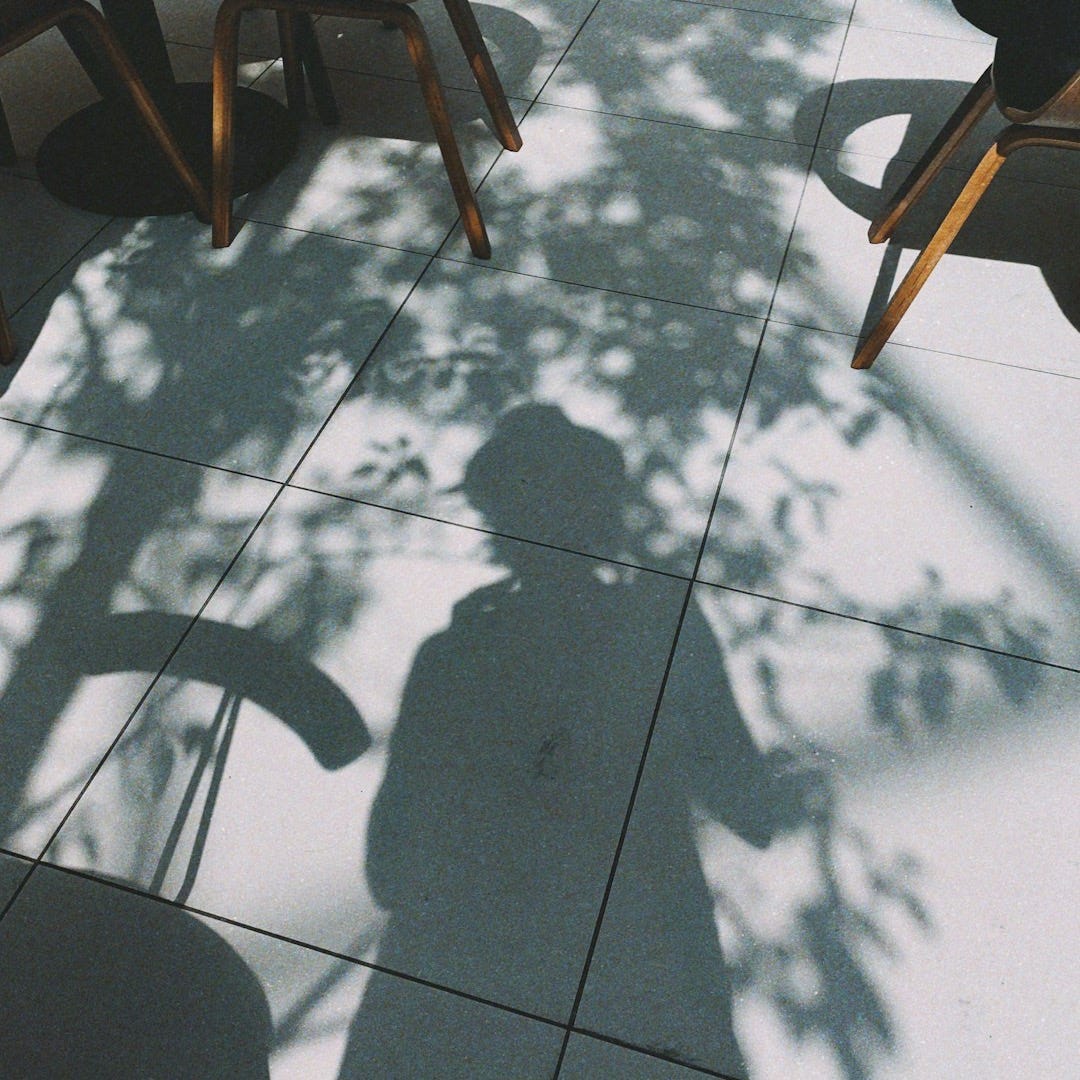
You may have heard the phrase “the shadow self” — a concept from the Swiss psychiatrist Carl Jung — but it’s often misunderstood. I found it super interesting to look into, especially to see if there was any relation to the home. After all, if our homes tell our story, does it tell all of it?
One thing to clear up right away, the shadow isn’t the “dark side” of a person in a moral sense. It’s simply the parts of ourselves that we push out of sight: the emotions we suppress, the impulses we deny, the traits we’d rather not admit we possess. Jung called it “the thing a person has no wish to be.”
And yet, these disowned parts don’t disappear. They slip into the unconscious, influencing our habits, relationships, and decisions in ways we rarely recognise. Think of the shadow self as the unswept corner of the psyche; the place where we store what we’d prefer not to face. What’s fascinating is that our homes can often reveal these hidden aspects long before we do. Our homes tell our truth if we let them. Here’s how…
The home as mirror of the psyche
If the body is the temple of the soul, then the home is its reflection in matter. Thus, it follows that every home must have a shadow. Not in the way light falls across a wall, but in the deeper psychological sense: the spaces, routines or habits that quietly hold the parts of us that we ignore.
The rooms we curate for others to see — tidy shelves, thoughtful styling, the best version of ourselves on display — belong to the persona, the socially acceptable self we consciously present to the world. But the awkward corners, overstuffed drawers, and closed-off rooms? Could these belong to the shadow? Because what we can’t bear to confront internally can sometimes accumulate externally?
Our homes are constantly offering feedback, quietly reflecting our patterns, priorities, pressures, and needs. Every choice we make — and every choice we postpone — is information. Not decoration for decoration’s sake, but clues. Signals. Breadcrumbs. In this sense, our surroundings become a kind of emotional seismograph: sensitive, honest, and often far more revealing than we intend.
Where the shadow might hide
But… life is full — work, family, young children, caretaking, exhaustion, the sheer admin of being human. So let’s be clear: a wild garden or a messy drawer is not automatically psychological symbolism. Sometimes it’s just life.
But occasionally, certain patterns persist not because of lack of time, energy or resources, but because something in us resists, avoids, or postpones. That’s when the home can start to whisper about deeper layers. Here are a few gentle possibilities — not diagnoses, but invitations to look closer if something resonates:
Neglect: The room you never enter, the corner you always overlook, the garden you “can’t face.” Sometimes it’s simply low bandwidth. But sometimes it hints at inner depletion, overwhelm, or a part of you you’ve put aside.
Excess: Surfaces that keep gathering things, shelves crammed despite regular attempts to tidy. Yes, busy lives create clutter. But sometimes excess becomes a buffer, a way to soothe, protect, or feel “enough.”
Discomfort: A space that feels oddly tense or unwelcoming, even though it looks fine. Not every room is everyone’s favourite, of course. But discomfort, a place the body doesn’t fully relax, can be a sign of emotional residue, or an unsettled memory. What happened here?
Avoidance: The drawer you never open, the paperwork you keep moving, the half-finished project you can’t bring yourself to complete. True, we all have “later” piles. But when avoidance becomes patterned, it can be a clue to emotions or decisions postponed.
The point is never to judge, but to notice. To ask, very softly: Is this circumstance, or is this something that is calling for my attention? None of this is failure. It’s information.
Bringing light to the dark
In Jungian psychology, integration is the process of becoming whole. In other words, the act of acknowledging all parts of yourself, not just the polished or socially acceptable ones. It’s the gentle, ongoing work of recognising what you’ve pushed aside, what you’ve outgrown, and what you’ve outmanoeuvred emotionally, and meeting those parts with honesty rather than judgment.
Integration isn’t about fixing anything; it’s about including everything. It is the opposite of denial, and the antidote to fragmentation.
In home terms, this same principle applies: tending consciously to the spaces we habitually avoid is a way of bringing the shadow into the light. The outer work becomes a mirror of the inner work. In this way, opening a long-ignored cupboard isn’t just decluttering — it’s courage. Mending something broken mirrors a desire to repair the internal, too. Clearing space is often tantamount to clearing stagnation.
Letting light into a dead corner is an act of inner mercy.
As Jung wrote, “I would rather be whole than good”, where wholeness means allowing the light and the shadow to coexist without shame.
A home, too, becomes more peaceful not when it’s flawless, but when it’s integrated — when no room is abandoned, no drawer feared, no part ignored. Because the goal was never a perfect home. It was an honest one. A place where everything belongs, and in that belonging, you are reminded that you belong too.
Whatever you do, if you enjoyed this post then please do hit the ❤️ button - it makes it more visible to non-subscribers. Thank you!
BTW I have a brand new website that brings together all the varied facets of my world in one place — the books, the Happy Insiders Club, my collaborations, my Amazon Shop — all now accessible via a single URL. Check it out! michelleogundehin.com

Hi Michelle, I only subscribed this year but I enjoy all your posts. This one in particular has really resonated with me, my mother died almost 2 years ago and I have most of her house living in my spare room. I walk in, and immediately walk out again, overwhelmed, not just about living with my loss, but incapable of saying goodbye to my childhood, my life. What you wrote, I think, will help me find the courage to look forward instead of looking back.
Though of course there’s always the possibility that I’m just incredibly lazy 😂.
Thanks again,
Daveen
This post chimed with me, also. I think my house only really came together after our house fire, which was a process that taught me a lot about myself, both in the immediate decisions - what you take from a burning house does, indeed, reveal something about yourself - and in the few weeks afterwards, when we were faced with ruin, not knowing if the insurance company would pay up. I remember us resolving to use the opportunity to travel, in a van, with the dog, which was hardly a long-term future but indicated certain priorities, too. I threw away so much stuff after that and I think I've gone too far the other way. The lack of stuff now points to someone who doesn't want to admit how rooted she is, who would like to pretend place is not vital to her, because I know it may be taken away randomly and is not, in reality, a safe space.